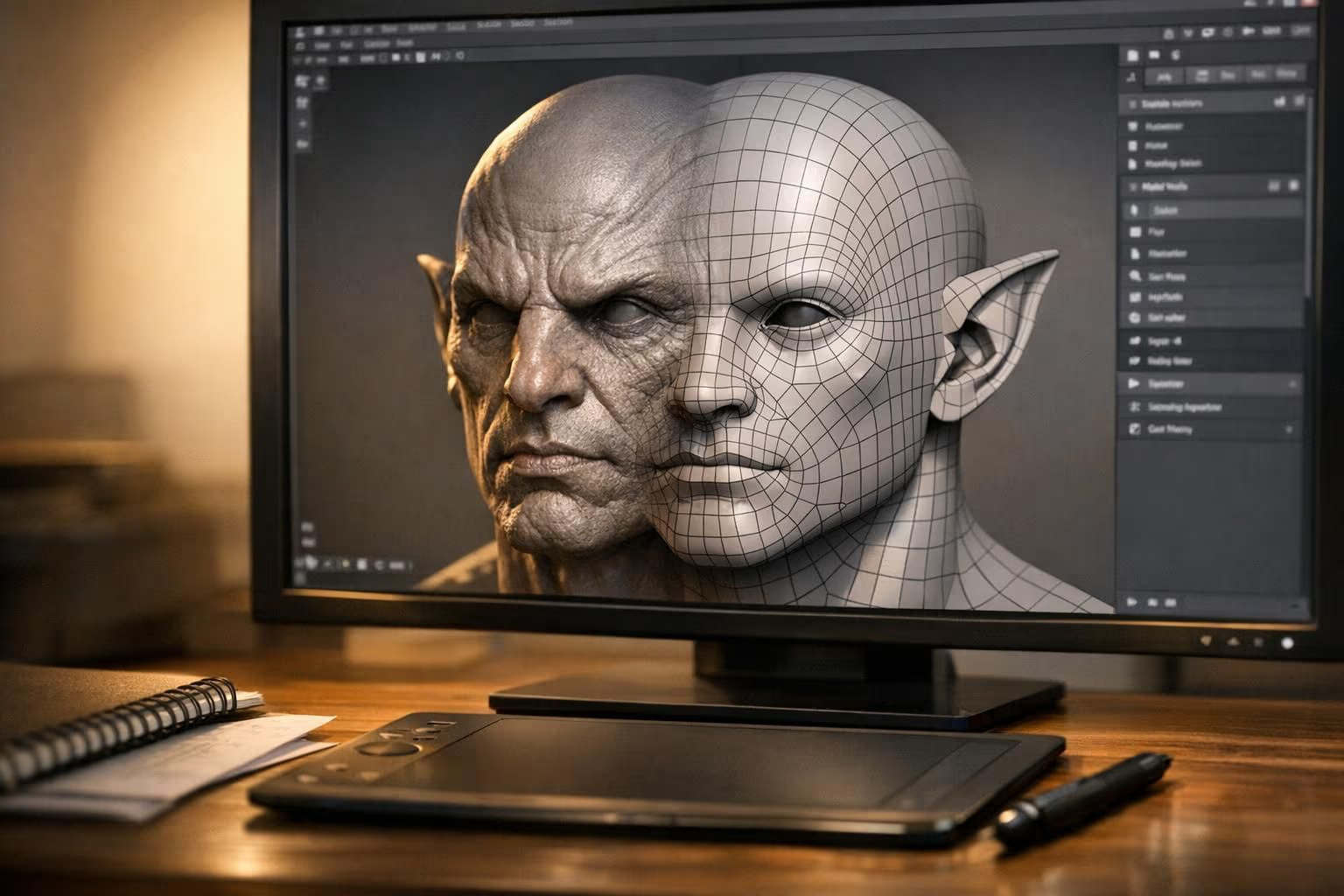
Topology
Topology in 3D modeling is the structure of a mesh: how its vertices, edges, and faces connect, what shape the faces have (triangles, quads, or n-gons), and how the edge loops flow across the surface. Two models can have the same shape but different topology. Good topology deforms, textures, and renders predictably.
What is Topology?
Topology describes how a mesh is built rather than what it looks like. It covers three things:
- Face shape: triangles (tris), four-sided quads, or faces with more sides (n-gons).
- Connectivity: which vertices and edges are shared, and whether the surface is closed or has holes.
- Edge flow: how loops of edges run around and along the form.
The shape of a model comes from the positions of its vertices. Topology is the network that connects them. That network decides how the model subdivides, deforms, takes UVs, and fits a performance budget.
Triangles, Quads, and N-gons
| Face type | Typical use |
|---|---|
| Triangles | Final format for real-time rendering. GPUs draw triangles, and GLB stores them. |
| Quads | Modeling, sculpting, subdivision, and animation, because edge loops are easy to follow. See quad topology. |
| N-gons | Temporary faces while modeling. They are triangulated on export and can shade badly. |
Why Topology Matters
- Animation: rigging and skinning bend the mesh along its edges, so joints need well-placed loops.
- Texturing: even, clean faces give cleaner UV mapping with less stretching.
- Performance: topology determines how many faces you spend and where. Wasted faces on flat areas cost polygon count with no visual gain.
- 3D printing: a closed, consistent surface is required for a watertight mesh.
When the topology of a model is wrong for its job, artists rebuild it with retopology or an automatic remesh.
Topology in Sloyd
Sloyd Text to 3D lets you choose the topology before you generate: auto, quads, or triangles, together with a target face count from 3,000 to 500,000 triangles. Quads suit models you will rig or edit further. Triangles suit models that go straight into an engine. The highest 500,000-face setting locks topology to triangles. The Sloyd API exposes the same choice as a request parameter, so a pipeline can request quads or triangles per asset without a retopology step afterwards.