The Cheaper Higgsfield Alternative: What AI Video Really Costs, and Where Your Money Goes
I priced Sloyd video against Higgsfield's published rates for a leading model in the same class: 2K, up to 15 seconds, with sound. Then I followed the marketing money.

All prices checked November 10, 2026.
If you're shopping for a cheaper Higgsfield alternative, this post prices Sloyd video against Higgsfield's published rates for leading models in the same class: 2K, up to 15 seconds, with sound. I also compare what it costs to extend a clip, to draft at a lower resolution, and to get in the door on each plan. Then I'll show the math, and follow the money — what the Higgsfield CEO has said about margins, and where the marketing budget comes from.
Full disclosure: I'm Avi, co-founder of Sloyd. So I have skin in the game. That's why every claim about Higgsfield below links to a source, and why I'll also tell you when Higgsfield is the better deal.
The bottom line
Sloyd figures below use regular monthly plans: Plus at $15 and Pro at $50. Higgsfield clip prices are for Hailuo 3 (MiniMax H3), a leading model in the same class. Extend uses Higgsfield's published price for +5 seconds at 720p, against Sloyd at 768p. Prices as of November 10, 2026.
| Higgsfield | Sloyd | |
|---|---|---|
| Entry plan | $19/mo (Starter, 270 credits) | $15/mo (Plus, 50 credits) |
| Mid plan | $59/mo (Plus, 1,200 credits) | $50/mo (Pro, 350 credits) |
| 5 s at 2K, best monthly rate | $0.86 (Ultra, $129/mo) | $0.86 (Pro, $50/mo) |
| 5 s at 768p / 720p | Not offered for Hailuo 3 (2K only) | $0.57 (Pro, 768p) |
| +5 s extend at 768p / 720p | $1.16–$2.46 (35 credits at 720p) | $0.57 (Pro, 768p) |
| 15 s at 2K, best monthly rate | $2.58 (Ultra) | $2.57 (Pro) |
| Lowest resolution, 5 s | 2K only, on Hailuo 3 | $0.29 (Pro, 480p) |
Higgsfield clip prices assume its published 20 credits per 5 seconds for Hailuo 3 at 2K, from its Hailuo 3 guide, at each plan's cost per credit from higgsfield.ai/pricing. Extend credits are from Higgsfield's editing guide. Sloyd: 2, 4 or 6 credits per 5 seconds at 480p, 768p or 2K. Both assume you use every credit you pay for, which nobody does, on either platform.
Here's what that table actually says:
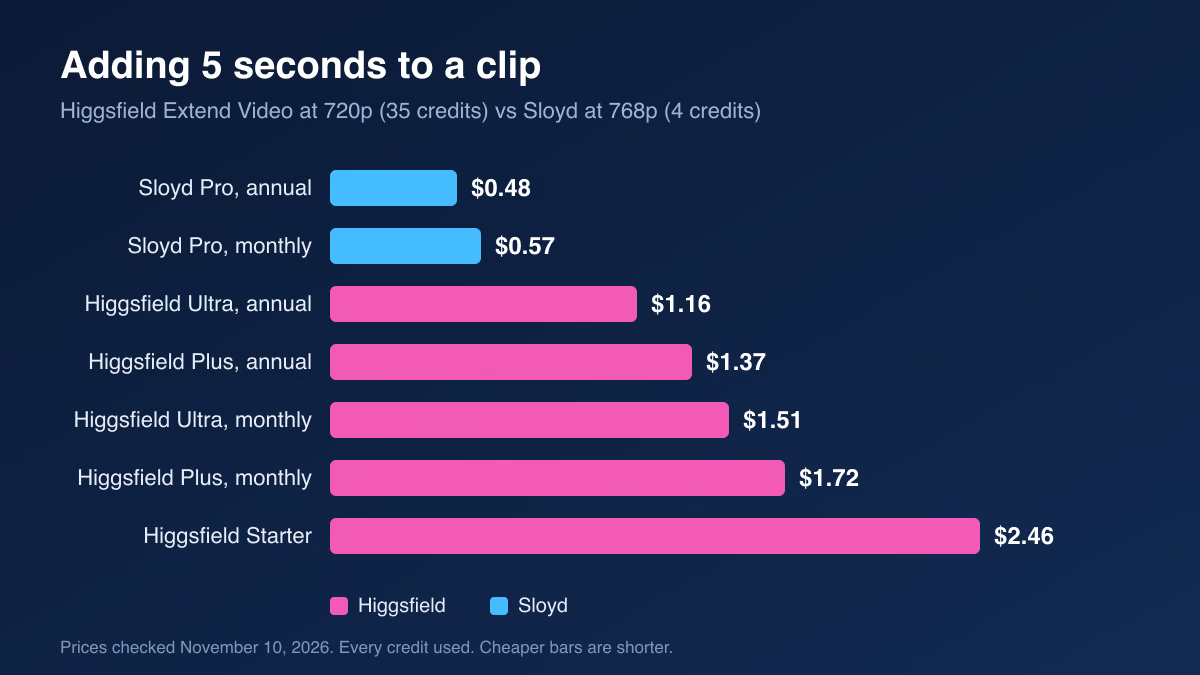
- Extending a clip is where the gap is widest. Higgsfield charges 35 credits to add 5 seconds at 720p, which works out to $1.16 to $2.46 depending on your plan. Sloyd Pro at 768p charges 4 credits for the same added 5 seconds: $0.57.
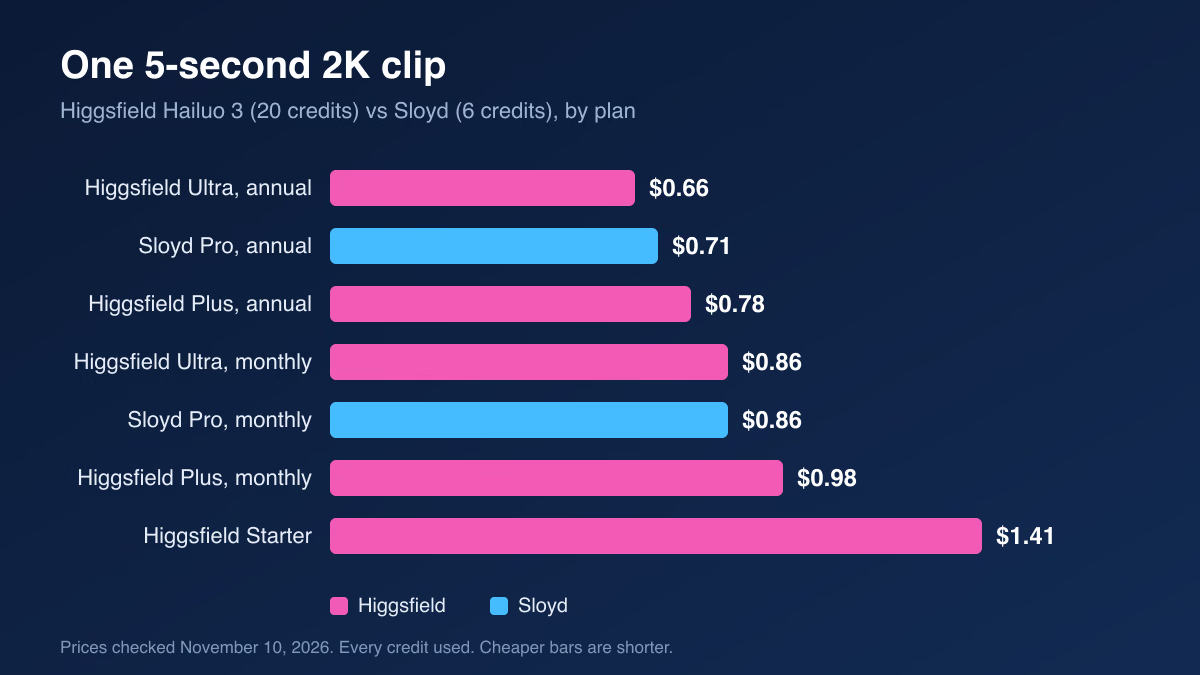
- A 2K clip is $0.86 on Sloyd Pro and on Higgsfield Ultra. Same per-clip price, except Ultra costs $129 a month and Pro costs $50. Against Higgsfield Starter ($1.41) and Plus monthly ($0.98), Sloyd Pro is cheaper per clip.
- You can draft cheaper on Sloyd. Hailuo 3 on Higgsfield is 2K only. On Sloyd, a five-second 768p draft is $0.57 on Pro, and 480p is $0.29. Most of a video budget is drafts. That's where the real savings live.
- The commitment is lower. Sloyd starts at $15 a month. Pro is $50. Higgsfield's paid plans are $19, $59 and $129.
Higgsfield still wins on some things. I'll cover those further down, after the math.
How I got the numbers
Higgsfield sells monthly credit bundles. As of November 10, 2026, its pricing page lists:
- Starter: $19/month, 270 credits
- Plus: $59/month, or $47/month billed annually, 1,200 credits
- Ultra: $129/month, or $99/month billed annually, 3,000 credits
Credits don't roll over. Higgsfield's own pricing explainer says unused credits expire when your plan refreshes.
A credit isn't a clip. Every model has its own rate, so to compare honestly you have to pick one model on Higgsfield and stick to it.
I used MiniMax's Hailuo 3, also called MiniMax H3. It's a leading model in the same class as Sloyd video: 2K, up to 15 seconds, native sound, start and end frames, and rich references. That's the fair fight. Pricing us against a cheaper or weaker model on Higgsfield would be cheating, and you'd notice.
Higgsfield's own Hailuo 3 guide lists it at 2K only:
- 5 seconds: 20 credits
- 10 seconds: 40 credits
- 15 seconds: 60 credits
A credit costs between 3.3 cents (Ultra, billed annually) and 7 cents (Starter). So one five-second Hailuo 3 clip on Higgsfield costs $0.66 to $1.41, depending on your plan. That's per generation, not per keeper. If you need three tries to get the shot (you will), triple it.
The "best monthly rate" in the table is Ultra billed monthly: $0.86 for five seconds at 2K. Starter is $1.41, Plus monthly is $0.98, Plus annual is $0.78, and Ultra annual is $0.66.
Sloyd's AI video generator works differently. You don't pick the model. You describe the shot, pick 480p, 768p or 2K, and Sloyd routes it. Clips can run up to 15 seconds. Every one comes back with sound.
Billing is by the second of finished video, whether you're creating, editing, extending or copying motion:
- 480p: 2 credits per 5 seconds
- 768p: 4 credits per 5 seconds
- 2K: 6 credits per 5 seconds
Sloyd Plus is $15/month with 50 credits. Sloyd Pro is $50/month with 350 credits. Those are the regular monthly plans, and they're the ones in the table. Regular annual plans, from our Stripe catalog, are $150/year for Plus and $500/year for Pro. On Pro annual, a five-second 2K clip is $0.71 and a 768p extend is $0.48.
Plus is the low-commitment entry plan: it comes with unlimited text and image to 3D, image creation and editing, and skyboxes, and it includes video at the same per-second rates. If video is most of what you make, Pro is the plan the table is built around, because that's where the per-clip price gets competitive.
One honest caveat, and it's an important one: a third-party quoting tool, Jutsu Studio, read Higgsfield's Hailuo 3 price as 2 credits per second (10 credits for five seconds) on a motion-transfer job on October 25. If that's the current price for regular clips too, Higgsfield's Hailuo 3 runs $0.33 to $0.70, and the 2K comparison moves a lot. I used Higgsfield's own published 20 credits. Check the Generate button before you trust either of us.
Edit, extend, and motion
A clip is rarely just a first generation. You edit it, you extend it, you copy motion from a reference. On Sloyd, those are the same 2, 4 or 6 credits per 5 seconds. Extend is billed only on the seconds you add, up to +15 at a time, and you can extend a clip that is already longer than 15 seconds. Motion takes a subject image and a motion video. You can also attach up to 9 reference images, 3 videos and 3 audio files (12 total) on one clip.
Higgsfield can do all of this, plus a bigger specialist toolkit: Relight, Reframe, Remove Background, upscale. The rate changes with the tool.
Higgsfield's own editing guide prices Extend Video, in Cinema Studio 4.0, at 35 credits for +5 seconds at 720p. That's $1.16 to $2.46 at current plan rates. The same added five seconds on Sloyd Pro, at 768p, is $0.57.
For motion, the closest like-for-like on Higgsfield is Hailuo 3 with a video reference: still 20 credits for five seconds at 2K, or $0.66 to $1.41. Sloyd Motion at 2K is the same 6 credits as any other clip, so $0.86 on Pro. Higgsfield also sells a heavier motion-transfer tool, Genjutsu, at 105 credits for 15 seconds at 720p (prices checked November 2, 2026). That's a different product, and a different bill.
I don't have a clean published credit price for a simple keep-the-length edit on Higgsfield, so I won't invent one. Both platforms will edit a finished clip. On Sloyd, that edit is the same per-second rate as creating one.
Who keeps the difference? What the CEO says about margins
So what does Higgsfield actually pay for that Hailuo 3 clip? I don't know, and I won't pretend to.
Here's what I do know. Hailuo 3 is an open-weights model: MiniMax published the weights on Hugging Face under a community license. The public APIs, MiniMax's own, fal.ai and Replicate, all list $0.13 per second at 2K, or $0.65 for five seconds (8frame, fal). And Alex Mashrabov has been unusually open about what open weights do to his margins.
On 20VC, per PJFP's summary of the episode, he said: "The margin on own models and open weights models is over 80%." On closed models, it's 20 to 30%. And Higgsfield gets to choose the model in over 40% of cases, which he calls "tokenomics."
He said the routing part on X, too:
Translation, mine, not his: the money isn't in the price tag of any single model. It's in owning your workflow and steering a big slice of it toward the models where Higgsfield keeps the most.
The most revealing quote is older. In an October 2025 interview with Evolving Edge, Alex tied the margins and the marketing together in one breath:
"Gross margins aren't like traditional SaaS - they're well below 80–90%. That's why growth and efficient user acquisition are critical to offset this profile. Cheap acquisition only happens when you stay on top of people's minds - when you're one of the loudest players."
Then in September, when Higgsfield crossed $1B in annualized revenue, this was one of the three highlights he listed:
"Positive gross margin since the beginning of this year."
Read that again. A company at a billion-dollar run rate, celebrating that gross margin has been positive. Since January.
Meanwhile, it spends over $4 million a month on internal model usage (20VC, via PJFP), raised $400M at a $5.4B valuation in August, eight months after a $1.3B valuation, and added Nvidia and TCV in October.
So here's my read, and it's an opinion. On Hailuo 3 at list price, Higgsfield charges 2% (Ultra annual) to 117% (Starter) over the public API price. The small plans carry the markup. The big annual plan is close to cost, at least at list price. And by the CEO's own logic, whatever margin there is has to pay for being "one of the loudest players."
Which brings us to the fun part.
Where your Higgsfield money goes: inside the marketing machine
"We don't do paid" (influencers aside)
On the 20VC podcast, Alex told Harry Stebbings: "We decided to really make a bet that we don't do paid. We don't do paid." Harry asked the obvious follow-up. "Is influencers not paid?" "That's a good point," Alex said. Then he explained how the influencer deals work: a fee for producing the video, plus cost-per-click attribution, "which works really well on YouTube." (20VC on YouTube, lightly cleaned up from the auto-transcript.)
I love this exchange. It's the most honest one-line summary of Higgsfield's business model I've heard, and it came from the CEO.
Higgsfield doesn't just pay creators. It is a content studio. Alex says more than 150 people at Higgsfield work in content production, and per the 20VC summary that's nearly half the company. Harry Stebbings' description was blunter:
"They have 150 people working in a content machine."
Paying creators to post (and what was in the kit)
In February, Forbes reported that Higgsfield offered game director Tim Soret $200 to share a post from a ready-made media kit. Soret noticed some clips weren't AI at all: they appeared to be Envato stock templates with Higgsfield logos pasted on. Co-founder Mahi de Silva told Forbes the kit was made for "ideation purposes" and shared by mistake.
"All this hype is fake and it's bought," Soret told Forbes.
The same story says creators were sent Google Drive folders of racist and obscene clips, plus non-consensual deepfakes of public figures, as promotional material. De Silva confirmed it: "It is absolutely not representative of our values, and it was a mistake." He also offered the line I'd frame and hang in every growth team's office: "We fully admit that we push the envelope... it's more controversial content that gets attention."
Then there's Higgsfield Earn, which pays users based on how viral their posts get. Forbes counted 10,000 creators and 50,000 videos in the first 20 days, plus Discord complaints about blocked withdrawals. De Silva said 90% of submissions had been paid. Some creators tell a different story:
In August, it was YouTube's turn. The Verge reported that big filmmaking creators, Matti Haapoja and Sam Kolder among them, posted Seedance 2.5 showcase videos that weren't labeled as ads. After publication, a Higgsfield PR manager confirmed the creators "were compensated through a negotiated combination of monetary payment and Higgsfield credits." Kolder's caption included what looked like an affiliate link for 30% off an annual subscription.
The stunts
In early February, Higgsfield promoted its motion design tool by bragging it had "ended" more than 20 creative jobs. To a community made mostly of creatives. The Register covered the backlash and the post's removal. AI creator Nick St. Pierre summed up the mood:
A few days later, Higgsfield's main X account was suspended. De Silva told Forbes that X cited "inauthentic behavior." Alex posted an apology that's worth reading in full, partly for the numbers at the end: $800,000 paid to more than 10,000 creators through Earn in three weeks, over $3 million in free credits, and $200,000 in contest prizes.
The stunts got bigger after that: an AI-generated stream with N3on, a feature film starring AI duplicates of YouTubers, AI movies premiered at Cannes. To celebrate $1B ARR, it reset everyone's used subscription credits for the rest of the month.
Every one of these is a growth expense. Paid for by subscriptions.
"Unlimited" (terms apply)
Higgsfield's favorite word is "unlimited." Its favorite footnote is "terms apply."
Forbes reported a Black Friday sale of 65% off and "unlimited" Nano Banana for $25/month. Users then said generation slowed to a crawl after a few videos. De Silva blamed bot attacks, said Higgsfield shut down about 40,000 accounts, and said it had refunded $1.35 million.
Today's pricing page is more careful: "Unlimited usage may be subject to dynamic speed adjustments during high-traffic periods."
The offers keep coming. Here's Seedance 2.5, "zero credit cost, all week":
And here's one of the replies:
Individual posts aren't data. Higgsfield has a 4.0 on Trustpilot from about 5,400 reviews, with 19% one-star. One analysis of Trustpilot's source breakdown found reviews written without an invitation were 47% one-star, versus under 1% for reviews the company invited manually. On refunds, Aliteq's reading of the terms is that you can get one on your first purchase, within 7 days, with zero credits used. Renewals never.
Some customers sum it up shorter:
To be fair, the machine works. $1B in annualized revenue. 40 million registered users. A $5.4B valuation. If you want to learn growth marketing, study Higgsfield.
Just know that when you subscribe, you're paying for the class.
Why Sloyd is the cheaper Higgsfield alternative
Our marketing department is this blog post. That's the pitch.
Here's what you get with Sloyd's AI video generator:
- A cheaper extend, and cheaper drafts. On Pro, adding 5 seconds at 768p is $0.57, against $1.16 to $2.46 on Higgsfield. A five-second 2K clip is $0.86, the same as Higgsfield Ultra, on a $50 plan instead of a $129 plan. Draft at 768p or 480p, and only pay for 2K on the take you keep.
- One price per second. 2, 4 or 6 credits per 5 seconds at 480p, 768p or 2K, whether you're creating, editing, extending or copying motion. No model math.
- No model research. Describe the shot. Sloyd picks the model.
- Sound with every clip. Ambience, effects and dialogue come back with the picture. Attach a voice line and the character speaks it in lip sync.
- Real control. Start and end frames, plus up to 9 reference images, 3 videos and 3 audio files (12 total) on one clip. Up to 15 seconds, six aspect ratios, MP4.
- The rest of the toolbox is included. Plus and Pro come with unlimited text and image to 3D, image creation and editing, and skyboxes, plus sound effects and voice-over on credits.
If you make ads, the AI UGC video generator workflow is the cheap way to do creator-style clips: generate your spokesperson as an image, attach the script as audio, render 9:16 with sound. Draft at 768p, keep the winner at 2K. Reuse the same creator across a whole batch, so swapping in a new product is a new photo, not a new shoot.
When Higgsfield is the better choice
I promised fairness, so:
- You want to pick the exact model for every shot. Higgsfield lists dozens of them. Sloyd picks for you.
- You already pay for a top-tier Higgsfield annual plan and make a lot of 2K clips. Ultra annual works out to $0.66 per five-second Hailuo 3 clip, against $0.86 on Sloyd Pro monthly, or $0.71 on Sloyd Pro annual. At that volume, the difference may not be worth a migration.
- You want 4K, 30-second single shots, or Higgsfield's preset effects and studio tools. Sloyd tops out at 2K, a new generation runs up to 15 seconds, and each extension adds up to 15 more.
For everyone else, especially anyone drafting a lot and keeping a few, a cheaper Higgsfield alternative is a few clicks away.
Open the AI video generator or make your first AI UGC video, and see what a clip costs before anyone pays an influencer to tell you.
Sources
- Higgsfield pricing page (read November 10, 2026): https://higgsfield.ai/pricing
- Higgsfield, "Higgsfield Pricing Explained": https://higgsfield.ai/blog/higgsfield-pricing-explained
- Higgsfield, "Meet MiniMax H3 on Higgsfield" (Hailuo 3 credit prices): https://higgsfield.ai/blog/minimax-h3-higgsfield
- Higgsfield, "How to Edit Videos with AI" (Extend Video credit prices): https://higgsfield.ai/blog/how-to-edit-videos-with-ai
- Higgsfield, "Meet Higgsfield Genjutsu" (motion-transfer credit prices): https://higgsfield.ai/blog/higgsfield-genjutsu
- Higgsfield API docs, MiniMax H3 (resolution fixed at 2K): https://docs.higgsfield.ai/docs/models/minimax-h3/reference-to-video
- fal.ai, MiniMax H3 text-to-video pricing: https://fal.ai/models/minimax/h3/text-to-video
- 8frame, Hailuo H3 price comparison (MiniMax API, fal, Replicate): https://www.8frame.co/blog/hailuo-h3-price-comparison-2026
- Jutsu Studio, Higgsfield cost per second: https://jutsustudio.com/blog/higgsfield-cost-per-second/
- MiniMax H3 open weights and license (Hugging Face): https://huggingface.co/MiniMaxAI/MiniMax-H3
- 20VC with Alex Mashrabov (YouTube): https://www.youtube.com/watch?v=jszn8rFtxm4
- PJFP, summary of the 20VC episode: https://pjfp.com/higgsfield-alex-mashrabov-1b-arr-20vc/
- Evolving Edge, "$0 to $50M ARR in Five Months": https://www.evolvingedge.io/p/0-to-50m-arr-in-five-months-alex
- Forbes, "Racist Videos And Payment Problems: The Dark Side Of This AI Startup's Super-Fast Growth": https://www.forbes.com/sites/rashishrivastava/2026/02/11/racist-videos-and-payment-problems-the-dark-side-of-this-ai-startups-super-fast-growth/
- The Register, "AI video company arouses fury by boasting about replacing creative jobs": https://www.theregister.com/software/2026/02/06/ai-video-startup-boasts-it-ended-jobs-gets-backlash/5059063
- The Verge, "Major YouTube creators are facing backlash for accepting AI money": https://www.theverge.com/ai-artificial-intelligence/983181/matti-haapoja-sam-kold-kolder-higgsfield-seedance-backlash
- TechCrunch, "Higgsfield raises $400M Series B": https://techcrunch.com/2026/08/17/higgsfield-raises-400m-series-b-quadrupling-its-valuation-in-8-months-to-5-4b/
- Higgsfield, Series B extension with TCV and NVIDIA: https://higgsfield.ai/blog/higgsfield-series-b-extension-tcv-nvidia
- Trustpilot, Higgsfield AI reviews: https://www.trustpilot.com/review/higgsfield.ai
- Vibedonalds, Higgsfield review (Trustpilot source breakdown): https://vibedonalds.com/blog/higgsfield-review
- Aliteq, "Is Higgsfield Legit and Safe?": https://aliteq.com/is-higgsfield-legit
- Sloyd pricing: https://www.sloyd.ai/pricing
- X posts embedded above: @alexmashrabov (2104650467833680068, 2103184279069168031, 2021356329416393164), @HarryStebbings (2104575734731637114), @FollowAurelius (2019027858476118118), @nickfloats (2018772595991015760), @higgsfield (2115929160447393797), @siddharth_820 (2116829239521776007), @bizdevelo (2118019528915607847)