How Mara Iversen Prototyped 26 Board Game Pieces in Two Evenings
Mara Iversen, a tabletop designer working on a four-faction strategy game, needed physical pieces for a playtest she couldn't run with abstract tokens. Using Sloyd's text-to-3D and image-to-3D generation with consistent style presets per faction, she produced printable pieces for the full game in two evenings of work.
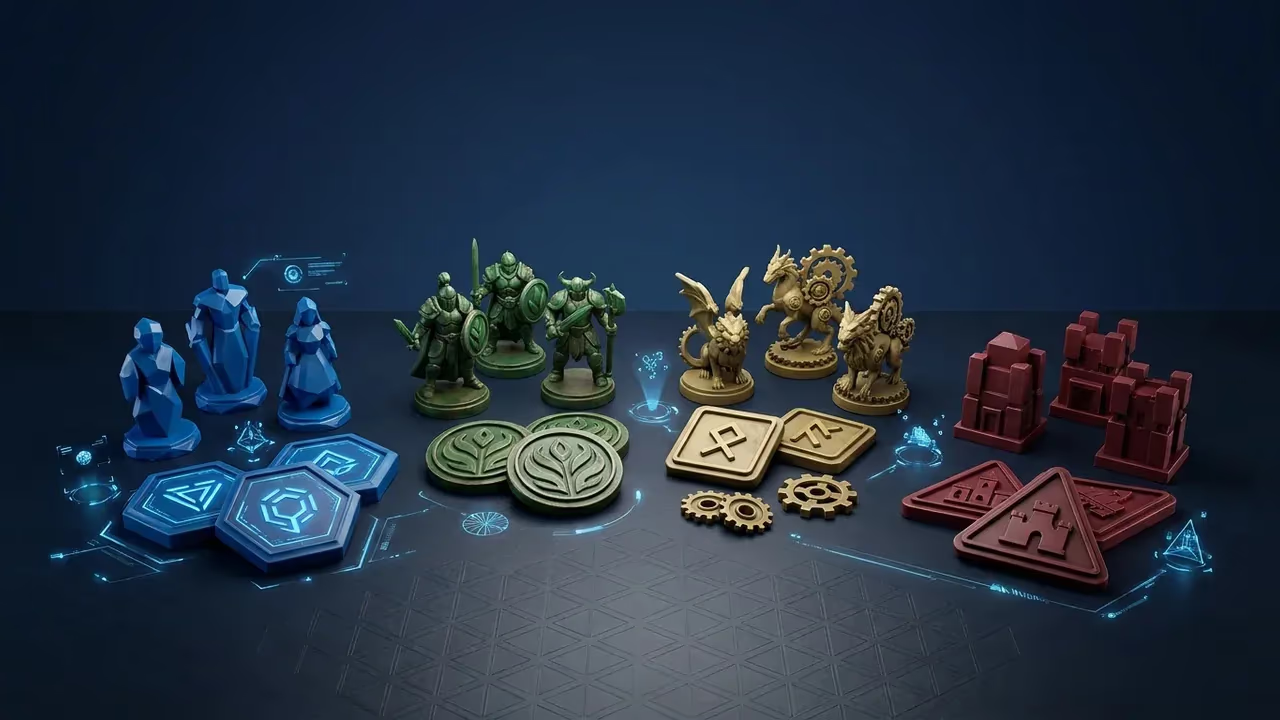
TL;DR: Mara Iversen needed 26 distinct printable pieces (four factions, six unit types each, plus neutral tokens) for a playtest of her strategy game Tideholds. She used Sloyd's text-to-3D and image-to-3D with a different style preset per faction to keep each faction visually coherent, printed the full set on a single FDM printer overnight, and ran the playtest on schedule.
The brief: pieces that communicate faction identity without a sculptor
Mara Iversen has been designing Tideholds, a four-faction asymmetric strategy game, for about eight months. The rules were ready to playtest with strangers, but the test required pieces that were visually distinguishable. Generic colored meeples wouldn't surface the feedback she needed about whether the factions felt different to play.
She had quotes from two miniature sculptors, both reasonable for a final production run, neither realistic for a prototype that might still go through three more rules iterations. She needed a way to put 26 distinct pieces on the table without committing real money to art.
Why generation, and why a faction-per-style approach
Mara's first instinct was to generate every piece with the same style preset and let the factions distinguish themselves by silhouette. That didn't work in her first test pass. With one consistent style, the orc-equivalent faction and the bandit-equivalent faction came out looking like minor variants of the same shape language.
She switched to a faction-per-style approach: one style preset per faction, applied consistently across all six unit types in that faction. The factions read as distinct immediately, and within each faction the units felt like they belonged together.
"The mistake I made early was treating style as decoration. Style is what tells the player 'these are the people you're playing.' Once I let each faction have its own visual language, the table started reading like a game instead of a sample sheet."
Mara Iversen, tabletop designer
The workflow
Mara's two-evening pipeline:
- Write a faction brief. For each faction she wrote a one-sentence visual description: "stout, low to the ground, hooded silhouettes" for one, "tall, angular, weaponed" for another. The brief picked the style preset and the prompt language for the unit prompts.
- Generate unit prompts in batches. For each unit type within a faction (worker, scout, soldier, archer, captain, hero) she ran three to four text-to-3D generations and picked the strongest silhouette. For the named hero units she used image-to-3D with a rough sketch as input, because she had a specific pose in mind.
- Stage on a virtual board. She imported the picks into a simple Blender scene to check that the factions read as distinct at table-viewing distance. Two units from one faction looked too similar to its neighbor and she regenerated them with sharper silhouette language.
- Print. All 26 pieces exported as STL, sliced in a single batch, printed overnight on an FDM printer with 0.2 mm layer height.
What needed manual work
Three of the smaller pieces came off the printer top-heavy and tipped over when the table was bumped. Mara fixed this in the slicer by adding a thicker brim and a 2 mm flat base extension rather than going back to regenerate. Two pieces flagged non-manifold in the slicer and she ran Blender's 3D Print Toolbox to clean them up, about ten minutes each.
One faction came out with two unit types that were nearly identical (the scout and the archer had similar poses). She regenerated the archer with more aggressive prompt language ("drawn bow, arrow nocked, weight back on the rear leg") and the new version distinguished cleanly.
The playtest result
Twenty-six pieces, four factions reading distinctly, total cost the price of one spool of PLA. The playtest produced feedback that was specific to the factions ("the bandit scouts feel too tanky given their stat line") rather than generic ("I couldn't tell my pieces apart"), which was exactly the discrimination Mara needed at this stage of development.
"The pieces aren't shippable in a published game. They're shippable in a playtest, which is a completely different bar. I'll commission a sculptor when the rules are locked. For now, having something on the table that tells a player which faction they're playing is the whole job."
Mara Iversen
Where this workflow fits
For a designer in the rules-iteration phase of a tabletop project, the gap between "what we're testing" and "what we're shipping" is the entire point. Production-grade sculpts are a downstream investment. Prototype pieces are a research tool. Generation closes the gap between abstract tokens and committed art at the right point in the design cycle.
If you're prototyping a tabletop project, the most useful constraint is to pick one style preset per faction and stick to it within the faction. The visual coherence does more work than any single piece's detail level.